Στην βιολογία, το περιβάλλον μπορεί να καθοριστεί σαν ενα σύνολο κλιματικών, βιοτικών, κοινωνικών και εδαφικών παραγόντων που δρουν σε έναν οργανισμό και καθορίζουν την ανάπτυξη και την επιβίωση του. Έτσι, περιλαμβάνει οτιδήποτε μπορεί να επηρεάσει άμεσα τον μεταβολισμό ή τη συμπεριφορά των ζωντανών οργανισμών ή ειδών, όπως το φως, ο αέρας, το νερό, το έδαφος και άλλοι παράγοντες. Δείτε επίσης το άρθρο για το φυσικό περιβάλλον και τη φυσική επιλογή.
Στην αρχιτεκτονική, την εργονομία και την ασφάλεια στην εργασία, περιβάλλον είναι το σύνολο των χαρακτηριστικών ενός δωματίου ή κτιρίου που επηρεάζουν την ποιότητα ζωής και την αποδοτικότητα, περιλαμβανομένων των διαστάσεων και της διαρρύθμισης των χώρων διαβίωσης και της επίπλωσης, του φωτισμού, του αερισμού, της θερμοκρασίας, του θορύβου κλπ. Επίσης μπορεί να αναφέρεται στο σύνολο των δομικών κατασκευών. Δείτε επίσης το άρθρο για το δομημένο περιβάλλον.
Στην ψυχολογία, περιβαλλοντισμός είναι η θεωρία ότι το περιβάλλον (με τη γενική και κοινωνική έννοια) παίζει μεγαλύτερο ρόλο από την κληρονομικότητα καθορίζοντας την ανάπτυξη ενός ατόμου. Συγκεκριμένα, το περιβάλλον είναι ένας σημαντικός παράγοντας πολλών ψυχολογικών θεωριών.
Στην τέχνη, το περιβάλλον αποτελεί κινητήριο μοχλό και μούσα εμπνέοντας τους ζωγράφους ή τους ποιητές. Σε όλες τις μορφές της Τέχνης αποτελεί έμπνευση και οι Καλές Τέχνες φανερώνουν την επιρροή οπού άσκησε σε όλους τους καλλιτέχνες με όποιο είδος Τέχνης κι αν ασχολούνται. Ο άνθρωπος μέσα στο περιβάλλον δημιουργεί Μουσική, Ζωγραφική, Ποίηση, Γλυπτική, χορό, τραγούδι, θέατρο, αλλά και όλες οι μορφές τέχνης έχουν άμεση έμπνευση από το περιβάλλον.

Δευτέρα 26 Απριλίου 2021

Melting the Eis: non-detection of kanamycin resistance markers by routine diagnostic tests and identification of new eis-promoter variants [Mechanisms of Resistance]

xloma.fota13 shared this article with you from Inoreader

Eis-promoter mutations can confer reduced Mycobacterium tuberculosis kanamycin susceptibility. GenoType MTBDRsl, a widely used assay evaluating this region, wrongly classified 17/410 isolates as eis-promoter wildtype. 6/17 isolates harbored mutations known to confer kanamycin resistance, and the remainder harbored either novel eis-promoter mutations (7/11) or disputed mutations (4/11). GenoType MTBDRsl can miss established and new variants that cause reduced susceptibility. These data highlight the importance of reflex phenotypic kanamycin testing.

View on the web

Overcoming culture restriction for SARS-CoV-2 in human cells facilitates the screening of compounds inhibiting viral replication [Antiviral Agents]

xloma.fota13 shared this article with you from Inoreader

Efforts to mitigate the COVID-19 pandemic include screening of existing antiviral molecules that could be re-purposed to treat SARS-CoV-2 infections. Although SARS-CoV-2 replicates and propagates efficiently in African green monkey kidney (Vero) cells, antivirals such as nucleos(t)ide analogs (nucs) often show decreased activity in these cells due to inefficient metabolization. SARS-CoV-2 exhibits low viability in human cells in culture. Here, serial passages of a SARS-CoV-2 isolate (original-SARS2) in the human hepatoma cell clone Huh7.5 led to the selection of a variant (adapted-SARS2) with significantly improved infectivity in human liver (Huh7 and Huh7.5) and lung cancer cells (unmodified Calu-1 and A549). The adapted virus exhibited mutations in the spike protein, including a 9 amino acid deletion and 3 amino acid changes (E484D, P812R, and Q954H). E484D also emerged in Vero E6 cultured viruses that became viable in A549 cells. Original and adapted viru ses were susceptible to SR-B1 receptor blocking and adapted-SARS2 exhibited significantly less dependency of ACE2. Both variants were similarly neutralized by COVID-19 convalescent plasma but adapted-SARS2 exhibited increased susceptibility to exogenous type I interferon. Remdesivir inhibited original- and adapted-SARS2 similarly, demonstrating the utility of the system for the screening of nucs. Among the tested nucs, only remdesivir, molnupiravir and to a limited extent galidesivir, showed antiviral effect across human cell lines, whereas sofosbuvir, ribavirin, and favipiravir had no apparent activity. Analogously to the emergence of spike mutations in vivo, the spike protein is under intense adaptive selection pressure in cell culture. Our results indicate that the emergence of spike mutations will most likely not affect the activity of remdesivir.

View on the web

External Evaluation of Two Pediatric Population Pharmacokinetics Models of Oral Trimethoprim and Sulfamethoxazole [Pharmacology]

xloma.fota13 shared this article with you from Inoreader

AAC_Cover_0.jpg

The antibiotic combination trimethoprim (TMP)-sulfamethoxazole (SMX) has a broad spectrum of activity and it is used for the treatment of numerous infections, but pediatric pharmacokinetic (PK) data are limited. We previously published population PK (popPK) models of oral TMP-SMX in pediatric patients based on sparse opportunistically collected data (POPS study, Antimicrob Agents Chemother 62:e01813-17, 2017, https://doi.org/10.1128/AAC.01813-17). We performed a separate PK study of oral TMP-SMX in infants and children with more traditional PK sample collection, and independently developed new popPK models of TMP-SMX using this external dataset. The POPS dataset and the External dataset were each used to evaluate both popPK models. The External TMP model had identical model and error structure as the POPS TMP model with typical values for PK parameters within 20%. The External SMX model did not identify the covariates in the POPS SMX model as significant. The External popPK models predicted higher exposures of TMP (median overprediction of 0.13 mg/L for the POPS dataset and 0.061 mg/L for the External dataset) and SMX (median overprediction of 1.7 mg/L and 0.90 mg/L) than the POPS TMP (median underprediction of 0.016 mg/L and 0.39 mg/L) and SMX (median underprediction of 1.2 mg/L and 14 mg/L) models. Nonetheless, both models supported TMP-SMX dose increases in infan ts and young children for more resistant pathogens with a minimum inhibitory concentration of 1 mg/L, although the required dose increase based on the External model is lower.

View on the web

Traumatic ischemic injury in a top of the basilar distribution: a case report

xloma.fota13 shared this article with you from Inoreader

Abstract

Background

Top of the basilar syndrome is a rare, heterogeneous disorder that has previously only been described in the setting of acute ischemic stroke in predominantly elderly patients. We present the first reported case of traumatic brain injury (TBI) causing ischemia in a top of the basilar distribution.

Case presentation

A 19-year-old woman suffered an acute subdural hematoma and sustained hypoxemia after being struck by a motor vehicle. Neurosurgical evacuation of the hematoma was undertaken. Magnetic resonance imaging revealed ischemic injury in the midbrain and diencephalic structures fitting a top of the basilar distribution. No associated vascular injury was identified. The patient was eventually discharged in a state of persistent unresponsive wakefulness.

Conclusions

Ischemia in a top of the basilar distribution may occur in the setting of TBI. A high degree of clinical suspicion is required to identify this disorder. Further study of the complex inflammatory microenvironment and associated tissue perfusion dynamics in TBI are needed in order to elucidate the mechanisms underlying ischemic injury patterns, develop management paradigms and predict prognosis.

View on the web

The frequency of cytomegalovirus non-ELR UL146 genotypes in neonates with congenital CMV disease is comparable to strains in the background population

xloma.fota13 shared this article with you from Inoreader

12879.jpg

Congenital cytomegalovirus disease (cCMV) is common and can be fatal or cause severe sequelae. Circulating strains of cytomegalovirus carry a high number of variable or disrupted genes. One of these is UL146, ...
View on the web

Episodic headache with spontaneous hypothermia reveal Shapiro’s syndrome variant with effectiveness of clonidine therapy

xloma.fota13 shared this article with you from Inoreader

10194.jpg

Episodic headache with spontaneous hypothermia constitute an uncommon association and is not well recognized in the International Classification of Headache Disorders (ICHD-3). Spontaneous periodic hypothermia...
View on the web

Cancers, Vol. 13, Pages 2100: BLBP Is Both a Marker for Poor Prognosis and a Potential Therapeutic Target in Paediatric Ependymoma

xloma.fota13 shared this article with you from Inoreader
Via Cancers

cancers-13-02100-g001-550.jpg

Cancers, Vol. 13, Pages 2100: BLBP Is Both a Marker for Poor Prognosis and a Potential Therapeutic Target in Paediatric Ependymoma

Cancers doi: 10.3390/cancers13092100

Authors: Durgagauri H. Sabnis Jo-Fen Liu Lucy Simmonds Sophie Blackburn Richard G. Grundy Ian D. Kerr Beth Coyle

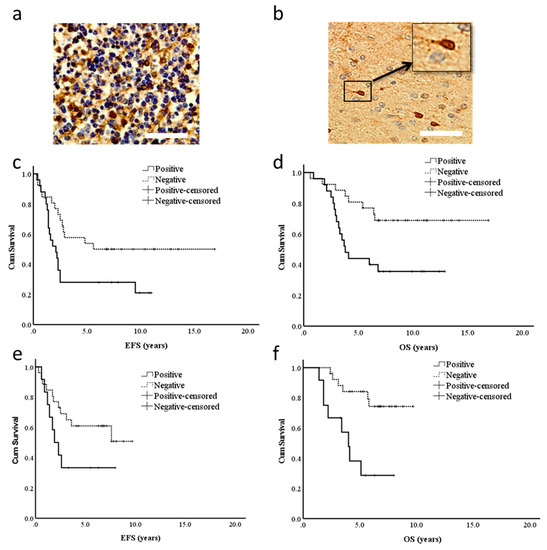
Paediatric ependymomas are aggressive, treatment-resistant tumours with a tendency towards relapse, consistent with a sub-population of therapy-resistant cancer stem cells. These cells are believed to derive from brain lipid binding protein (BLBP)-expressing radial glia, hence we proposed that BLBP may be a marker for ependymoma therapy resistance. BLBP protein expression correlated with reduced overall survival (OS) in patients from two trials (CNS9204, a chemotherapy-led infant trial—5 y OS 45% vs. 80%, p = 0.011—and CNS9904, a radiotherapy-led trial—OS 38% vs. 85%, p = 0.002). All ependymoma cell lines examined by qRT-PCR expressed BLBP, with expression elevated in stem cell-enriched neurospheres. Modulation of BLBP function in 2D and 3D assays, using either peroxisome proliferator activated receptor (PPAR) antagonists or BLBP's fatty acid substrate docosahexaneoic acid (DHA), potentiated chemotherapy response and reduced cell migration and invasion in ependymoma cell lines. BLBP is therefore an independent predictor of poor survival in paediatric ependymoma, and treatment with PPAR antagonists or DHA may represent effective novel therapies, preventing chemotherapy resistance and invasion in paediatric ependymoma patients.


View on the web